
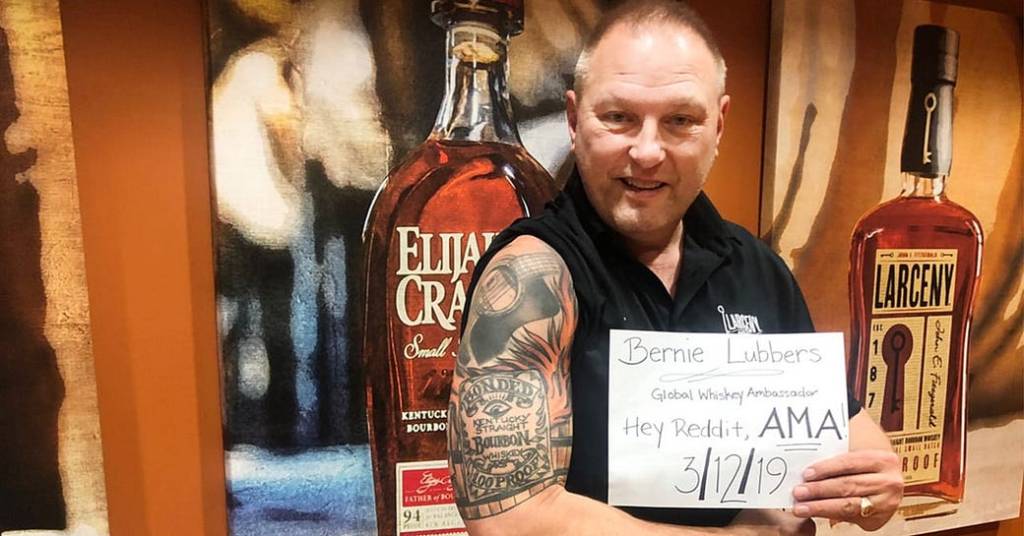
Bourbon is big business and trends are always changing. It’s always handy to talk to experts, and there are few people on the planet more experienced in bourbon than Heaven Hill’s brand ambassador AKA the Whisky Professor, AKA Mr Bernie Lubbers himself.
It was a pleasure to sit down with Bernie and discuss the history of Heaven Hill, why whisky and country music go together and new products on the horizon.
Before you were in the whisky industry, you were a standup comedian. How do you feel that experience has helped you in your role as a bourbon ambassador?
That’s right. I came into the bourbon industry in 2005 and believe it or not there were only 10 distilleries in Kentucky at the time, making up 95% of the world’s bourbon. The only ambassadors that were representing the distilleries were the distillers themselves. They were production and technical based people who didn’t have the skills to stand in front of a group of strangers and deliver a talk.
Coming from the comedy world, that gave me an advantage. My first role in the whisky industry was working at Jim Beam and I’d already been putting those skills to use by running events and promotions at corner bars to have people taste their products.
Instead of using a pre-approved slide deck, I decided to write my own bourbon presentation for a representation of Knob Creek’s nine year product. Since I wasn’t a distiller or a member of the Beam family, I decided I was going to talk about the words on the label and no one was doing that back in 2005. That put me on the map and I was hired as one of the first official ambassadors for Knob Creek.
Without my comedy background, I’d probably have been scared shitless to put myself out there like that and do something that no one else was doing.
That’s great to hear. I feel like the whole bourbon industry has been built on taking risks.
What’s the overarching history of bourbon in Kentucky for those who’re unfamiliar with it?
So, it’s definitely part of the Kentucky culture and I grew up in Louisville. My mum and dad drank bourbon, even though my dad worked at a brewery. Bourbon was the only spirit we had in the house and when I was young, it was on the way out in terms of industry trends and drinking habits. But being from Louisville, it was every day stuff to us and was always around.
It wasn’t until I got into the industry and started talking about the words on a label that I saw how trends develop and come back around. Early on, I researched Pappy Van Winkle and his company, Stitzel Weller, had taken out advertisements on how to read a bottle. So, that confirmed to me I was on the right track. Everything comes back around every 20 – 30 years.
The deeper I went into my research, the more I learned about the rich histories behind the people who created bourbon. Whenever I’d pick up a bottle in training or tastings, I’d tell my audience that the person on the label has a story. The story was what gets people interested.
As a storyteller and comedian, I’ve focused on my strengths. I’m not a distiller or in production. I’m the face of the brand in the marketplace. Because when I first started bourbon training, distillers were telling me about fermentation and temperature settings and I was like ‘why are you telling me all this technical stuff that I’ll never be able to present?’
So, I told them to give me something I can digest. Give me something I can get excited about that’ll make me want to drink the products, so I can get customers excited about doing the same thing.
I agree with you about storytelling being vital in the drinks industry. Speaking of stories, what interesting tales have come out of Heaven Hill over the years?
Are there any colourful characters who come to mind for you?
Absolutely. The stories about the founders of Heaven Hill is incredible. Because unlike other whisky brands we don’t date back to the 1700s or 1800s. Heaven Hill began in 1935 with five brothers, the Shapiras, who owned small department stores in towns like Bardstown, Lebanon and New Haven in Kentucky.
At the time, America was experiencing the effects of prohibition and the the depression. But the Shapira’s department stores weren’t badly impacted because they were selling everyday goods like shirts, shoes, hats etc.
So, let’s keep in mind these brothers were young. They were in their late twenties and thirties, but they had an eye for business and for spotting talent. They met the legendary Harry and Joe Beam, two brothers who had gone down to Juarez, Mexico to distill bourbon with a woman called Mary Dowling back in the prohibition days. At the time, it was legal to make bourbon in another country then. That’s crazy to me.
Together, the Shapiras and Beams invested into the company that would become Heaven Hill. As Mark Shapira, the current owner, has told me it was between $18,000 – $20,000 and that was a lot of money back in 1935.
From there, the first Heaven Hill barrel was made on the 200 acres of Bardstown land on December 13th 1935. It was a Friday, so Friday the 13th is lucky for us.
For the Shapiras, the collaboration with the Beam family was a bet. They saw an opportunity to be at the centre of the bourbon universe in Bardstown.
That’s really fascinating and something that stands out to me a lot about Heaven Hill is the huge range of brands that the distillery owns.
Some of my favourites include Rittenhouse, Pikesville and Larceny and it’d be great to learn more about the stories behind those brands.
When it comes to brands, there’s a way that companies build their franchise players. Sometimes it’s planned and sometimes it’s by mistake. I always tell my audience that brands are like children. You never know which ones are going to be successful and shine. Meanwhile, there will be others who you’ll need to help and support for their whole lives.
The first bottle produced with the Heaven Hill name was called Old Heaven Hill and it was a four year old bottling. Before that, there had been a two year old whisky made to get some money coming in and the next step was to get a bottle with the name on it.
The brothers bought land with a farm on it called William Heaven’s Hill farm, which was the owner of the farm’s name. It turns out there was a mistake when the distillery licence was printed out. Somebody had put a space between Heaven and Hill. The Shapiras called the county up and said we need to change it and the answer was it’s going to cost them a $25 refiling fee.
So, the distillery kept the name on the licence because they knew that the industry standard was bottled in bond. For bottled in bond, it takes four years of aging for a bourbon to come out, so that wasn’t a burning issue at the time. The brothers figured they’d spend the $25 to change the name after the four years.
But in that time, they fell in love with the name because Heaven Hill sounded like a place to drink heavenly bourbon. Boom. That bottle came out in 1939 and it became the number one selling bourbon in the state of Kentucky. Even then, the Shapiras knew they were onto something.
Then WW2 broke out and distilleries like Heaven Hill were given contracts from the government to make high proof alcohol for the war effort. So, that was four more years of a product not being on the shelf. The money was coming in, but those war years didn’t help the brand itself.
After the war, the Old Heaven Hill brand name was pushed and made money through the 1960s, 1970s and 1980s. But there was still a bad atmosphere for American whisky going on in the US because under the bottle in bond regulations, Heaven Hill was still sticking to the four year production time and aging. Brands like Johnny Walker and Canadian Club were dominating the market.
In the 1970s, Ed Shapira, Max’s father, made a shrewd business decision. He noticed that a lot of distillers were going out of business and made the move to buy out brands like Rittenhouse Rye. Because it wasn’t just buying the brand. Heaven Hill got all the barrels the whisky was resting in for future production, meaning the whisky could be left to age. This method paid for overheads and the distillery could focus on making its Heaven Hill in the mean time.
Some of the brands bought in the ‘70s and ‘80s included J.W Dant, J.T.S Brown and Pikesville. Another business decision we’ve stuck with for the most part is not changing the label of these brands because they are recognised and have a legacy. Brand buying has kept on going into the modern day.
As well as yourself, there are lots of other folks championing the Heaven Hill products like master distiller Conor O’Driscoll.
What do you think he brings to the table?
Conor is amazing at what he does and I can say that from having worked at the two biggest bourbon companies in the world. He’s the only guy I know who’s had experience running small, medium and large distilleries. He’s worked pot stills at Woodford and column stills and done everything in between.
One of his biggest strengths is that he’s come in with a younger set of eyes and is moving Heaven Hill forward for new generations and that does make a difference. Because sometimes you just do what your daddy said, right?
That’s certainly true with Parker Beam, who was the master distiller emeritus when I first started. He should be on the Mount Rushhmore of distillers but he was always focused on distilling exactly like his dad, Earl Beam did. H was the master distiller after WW2 before Parker took over in 1960. If Earl told Parker to do it a certain way, it’d be done a certain way.
I remember Parker always using his body to try and figure out what the state of the bourbon would be like. He’d make assumptions based on how the temperature rose and how it made him feel.
Now, doing things the traditional way can be good but it also hinders you. Connor is willing to experiment and make the best possible spirit he can make.
One more thing about Connor I’ve noticed is he’ll put his foot down and take a stand against the usual way of doing things when a company might be building a new distillery and they pay consultants a bunch of money to tell them what to do. But he’s ballsy enough to say we’re going to do things our own way and stand by the name that’s on our bottles.
I’m a big country and blues fan and the genre has whisky as a major motif. Why do you think whisky is such a big part of that genre?
I’ve got a few thoughts about this. First, I have a bluegrass band called The Bottle in Bond Boys and I think there’s a tendency for whisky brands to show up in songs because maybe the singer has a particular love for them or because the marketing has been so powerful already that the image has become associated with a mood.
For example, bands are going to always play in bars and there will be people in the audience drinking Jim Beam, Jack Daniels, Johnny Walker etc. Any lyrics that have whisky in them might heighten that drinking experience.
Another possibility is that the band is looking to get some kind of marketing deal with a well-known distillery or brand. But these cases are rare and that runs the risk of making music disingenuous to some folks.
If you could share a glass of bourbon with everyone in history, who would it be and why?
That depends on what mood I’m in and what day of the week it is. Today, I’ll say it’d be Henry McKenna. My favourite bourbon is named after him and he sounds like a fun guy to drink with.
He was an Irishman from County Derry who came to America to cut roads and turnpikes. A real, hard working guy. He had a grist mist and would take excess grains to barter with other farmers. He took the grains he wanted to grind and kept a percentage of it as payment and then turned it into whisky and made money.
McKenna went back and forth between Ireland and the States and became a well-off guy by doing this whisky making strategy. Also, he was a frugal fella. His children built a house for him on his property they thought he’d be proud to live in instead of the shack that he’d been used to.
When he saw it, he refused to live in the house because he thought it was too opulent for him.
I’ll have to read up about him. I appreciate you being generous with your time, Bernie.
My last question is do you have any exciting updates or products you’d like to drop about Heaven Hill?
We’ve recently relaunched our flagship Heaven Hill Brand, and now that shines alongside our our Evan Williams Brand #2 selling Bourbon and Elijah Craig and others.
Mostly, Heaven Hill has stayed within Kentucky and a couple of other states and Evan Williams has been the value brand for the company in the past. We’ve spent the last 10 – 12 years trying to revamp the name because it’s the name of the facility that we started at.
So, we discontinued the value bourbon brand and then relaunched with a 27-year-old Heaven Hill Select too. Other recent releases are a 20-year-old corn and an everyday 7 year old bottle in bond.
In August, we’ve got a grain to glass release, which is grains that have been grown at the distillery in Bardstown. The corn wasn’t grown there, but the wheat is Kentuckian. There are three different recipes of that and it’s a six-year-old product.
Heaven Hill isn’t the first to do it. But the whole Shapira family are excited to bring it out, especially Max, who even at 80 is spry as ever and in the office six times a week.
 Americana Aspects
Leave a reply to The Weird And Wonderful History Of Bourbon – Americana Aspects Cancel reply