
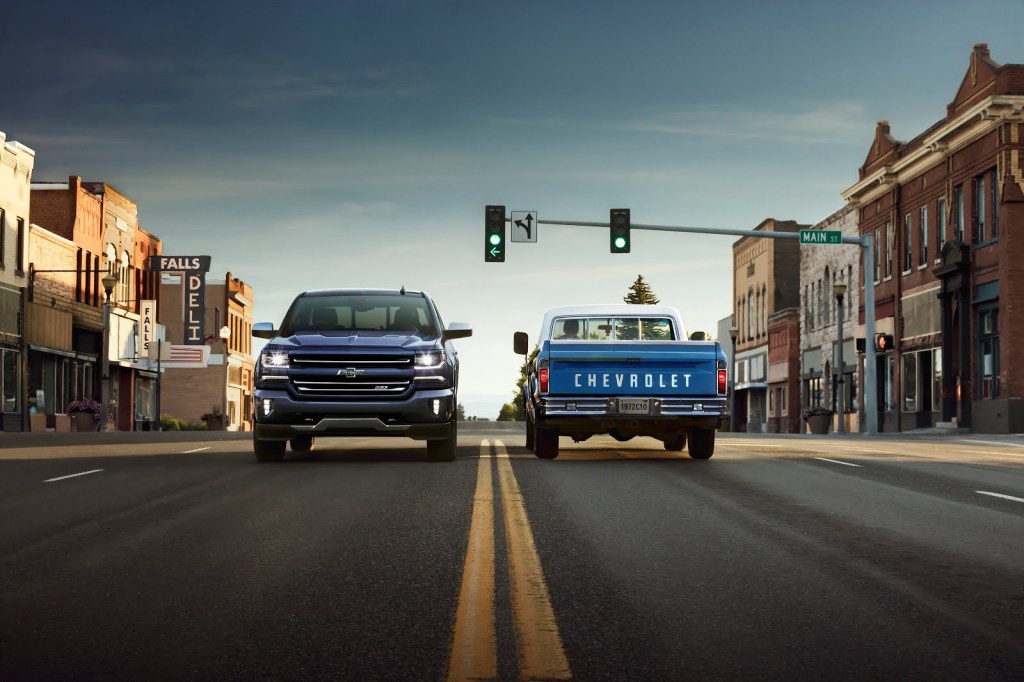
Country music goes deeper than an art form or means of entertainment. It operates as an ecosystem of signs that communicate community, identity, values, meaning and belonging through objects that appear deceptively ordinary. Much like bourbon, the pickup truck occupies a central position within this symbolic world and among these trucks, the Chevrolet Silverado has emerged as one of the most recognisable and culturally loaded emblems.
To approach the meaning of the Chevy Silverado in this context properly, we must step outside material reality. Semiotics, particularly the work of the philosopher Roland Barthes, offers a framework for understanding how objects become mythologised. In this framework, the Silverado becomes a sign that’s been transformed far beyond industrial origins and a mere vehicle. In their place, a dense network of meaning tied to freedom, labour, masculinity and memory appears.
The Silverado As A Sign: From Industrial Object To Cultural Myth
The Chevy Silverado begins as a utilitarian object. It’s designed for towing, hauling, movement and durability. These are all features that speak to function, efficiency and mechanical reliability. In everyday life, the truck belongs to the world of work and commerce with a presence at construction sites, farms, highways, all of which are embedded in systems of labour and production.
Within the container of country music, these associations are stripped away almost entirely. The Silverado changes into a cultural artefact and listeners are invited to experience it as a representation of independence, a marker of personal history, a vessel in which life happens, a getaway from heartbreak, a gateway to finding the one true love.
Barthes’ concept of myth definitely helps with clarifying this transformation and it’s important to note that myth doesn’t erase the original object. The Silverado comes to appear as though it always belonged to the cultural imagination of rural life, even though it’s a product of modern industry and global manufacturing. The truck’s presence in a song naturalises a specific vision of identity. One that’s rooted in self-reliance and mobility without drawing attention to the constructed nature of the vision.
Let’s look at examples of how this happens.
The Road As A Stage For Becoming
Movement is a central pillar in country music’s storytelling. The road is never just a setting and it’s a space for change and freedom to become possible. Within this narrative structure, the Silverado serves as vehicle and stage, carrying characters through moments of change while simultaneously framing those moments.
The act of driving introduces a sense of openness that fixed locations can’t provide. A house suggests stability and routine whereas a bar suggests repetition or familiarity. The truck, by contrast, exists within motion. Characters leave, return, escape or wander without a clear destination. This mobility brings a narrative elasticity in which time feels suspended and possibility expands.
To this end, scenes within or around the Silverado tend to carry emotional weight because they are happening within the transitional space. Two songs from Morgan Wallen show this: Sand In My Boots and Silverado For Sale.
In the former song, Wallen sings about a fling with a woman he hopes will turn into something more, only for her to leave him as quickly as she seemed to appear. His heartbreak is palpable, framed through the lyrics:
Yeah, but now I’m dodging potholes in my sunburnt Silverado
Like a heart-broke desperado, headed right back to my roots
The Silverado has become a deliverer of escape, a trusted and familiar friend ready to take the persona of Wallen’s song back home. The truck bears marks from the sun, marks that could be seen as wounds to match the emotional scars of the persona.
In the latter song, the narrative is much different with Wallen ready to pass his Silverado on with lyrics like:
This truck will get the prettiest girl in town
Sittin’ right beside you when you’re ridin’ around
It’s got a pretty good radio
If you wanna get her dancin’ down an old dirt road
Spent a lot of Friday nights up under the stars
Get you where you need to go, and it’ll go too far
God knows all the stories it can tell
I got a Silverado for sale
Here, the Silverado is a vessel of hope and young love. A symbol of upward mobility in a small town, as much as a literal object of motion to take lovers wherever they want to go. In both instances, movement is constant. So, in this context, the Silverado embodies a form of agency that extends beyond transportation, shaping how individuals understand themselves and their place in the world.
Masculinity And The Extension Of The Self
Country music frequently engages with questions of masculinity, usually presenting it as something expressed through action and endurance. The Silverado becomes entwined with these ideas by functioning as an extension of the self i.e. a physical manifestation of qualities that might otherwise be abstract.
The truck’s scale and design contribute to this symbolic role. For example, its size conveys presence and strength, while its durability suggests resilience under pressure. Signs of wear like scratches and dents take on the meaning of marks of experience rather than damage. They imply a life lived through labour, travel, exposure to the elements or a hard way of living that has left the driver unfazed and even richer for the experience.
The Truck Bed As Ritual Space
While the Silverado truck is associated with movement, it also creates spaces of stillness that bring their own symbolic weight. The truck bed in particular becomes a site of ritual in country music and an environment where ordinary activities gain heightened meaning through repetition and context.
Moments spent in the truck bed involve sharing drinks, watching sunsets, listening to music, sitting in silence, making love and so much more. These types of scenes are always characterised by a sense of physical and emotional openness where there is an absence of boundaries and traditional social expectations.
Kane Brown’s Miles On It is a great example of the truck bed as a ritual space:
New truck, big lift, old roads, we’ve been
Tearin’ up since way back when
But these wheels are innocent
New hitch, new seats, no history
And you just can’t fake that, so let’s change that
Girl, let’s go put some miles on it
Back of the Chevy with the engine runnin’
Just you and me in a truck bed wide like a California King
We could break it in if you know what I mean
These lyrics turn the Silverado into a safe space for romance and playfulness. There’s a freedom that can’t be achieved anywhere else but the intimate space of the truck bed that has all the comfort of a California King bed on wheels.
The Enduring Paradox
There is undoubtedly an enduring presence about the Silverado in country music and also a paradox. The truck is a product of large-scale industrial processes, designed, manufactured and marketed within a global economy. Its very existence depends on systems that are far removed from the rural landscapes it inhabits in country songs.
Despite this, the Silverado functions in songs as a symbol of freedom, simplicity, independence and resistance to modern complexity. This contradiction reflects the broader pattern that Barthes’ identified in his philosophy of modern myths transforming manufactured objects into representations of natural life. The industrial origins of the Silverado become invisible, replaced by an image that feels organic and authentic.
Fans of country music engage with this image because it resonates with cultural expectations and emotional experiences. The Silverado’s symbolic meaning aligns with narratives of identity and belonging that are deeply embedded in the genre, making its authenticity a matter of perception instead of origin.
 Americana Aspects
Leave a comment