The world of drink advertising is a fascinating space for the storytelling mechanisms and ideas that are conveyed through the presentation of a product. Old-school drinks ads in particular are interesting because of their visual depth and narrative structure.
A category that has done this to great effect throughout the decades is bourbon, with many brands relying on provocative or eye-catching ads to promote values of the American dream, white picket fences, a certain kind of manhood and a shift towards inviting more women into the space.
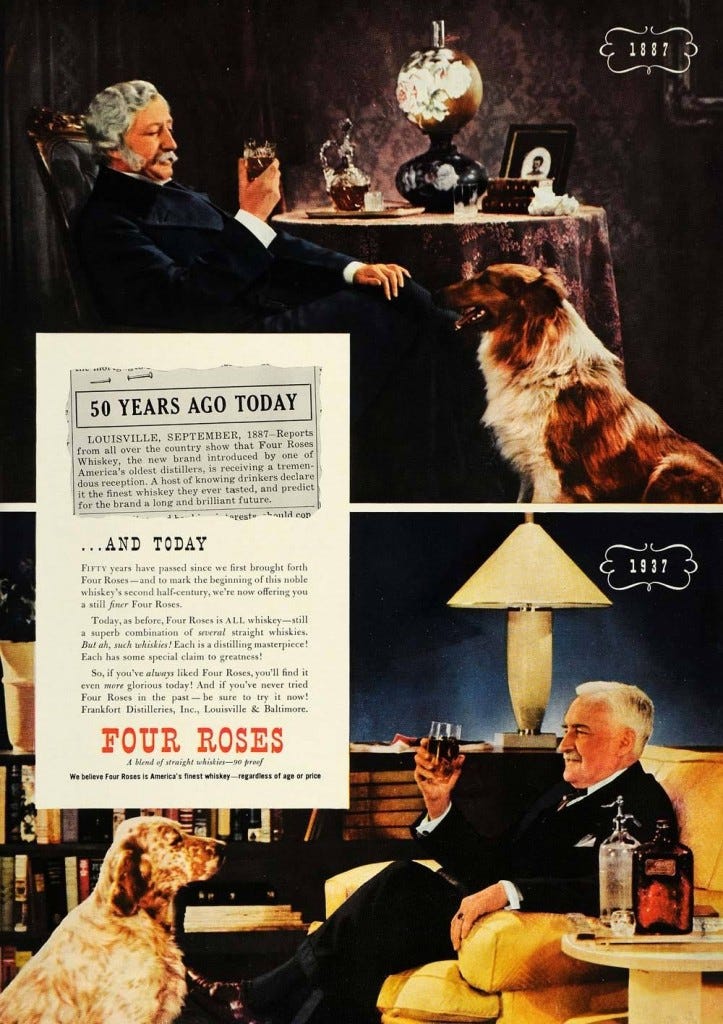
One of my favourite bourbon ads comes from Four Roses that was done in 1937.
Copy overview
50 YEARS AGO TODAY
Louisville, September, 1887 – Reports from all over the country show Four Roses Whiskey, the new brand introduced by one of America’s oldest distillers, is receiving a tremendous reception. A host of knowing drinkers declare it the finest whiskey they ever tasted, and predict for the brand a long and brilliant future.
…AND TODAY
Fifty years have passed since we first brought forth Four Roses – and to mark the beginning of this noble whiskey’s second half-century, we’re offering you still finer Four Roses.
Today, as before, Four Roses is ALL whiskey – still a superb combination of several straight whiskies. But ah, such whiskies! Each is a distilling masterpiece! Each has some special claim to greatness!
So, if you’ve always liked Four Roses, you’ll find it even more glorious today! And if you’ve never tried Four Roses in the past – be sure to try it now!
Frankfort Distilleries, Inc, Louisville & Baltimore.
FOUR ROSES
A blend of straight whiskies – 90 proof
We believe Four Roses is America’s finest whiskey – regardless of age or price
Branding associations and emotional resonance
Heritage: The most overt association that this ad is trying to evoke is a sense of heritage and tradition. According to the ad, Four Roses was first created in 1887 and from those early days, the people who tried it knew it was going to be special.
The newspaper clipping style of the first paragraph makes it seem as if the copy could have been taken from an actual newspaper and that’s contrasted with the fifty-year leap to demonstrate Four Rose’s credibility as an established, venerable brand.
Luxury: This ad is definitely a product of its time in that it’s catering only for men and positioning Four Roses as a luxury item. All you have to do is focus on the classic old men in armchairs motif to see what I mean.
There’s another interesting layer in this association. Four Roses are aping classical motifs from Scottish whisky to show that bourbon has the potential to be every bit as elegant and luxurious at a time when bourbon was going through an identity crisis in the years before the Second World War.
Loyalty: The inclusion of dogs represents loyalty, communicating to readers that Four Roses is a trusted brand that’s loyal to giving them the best possible drinking experience.
There’s also a sense of continued mythology with the two old men. It’s possible the guy from 1937 is related to the guy from 1887.
This is an example of a brand flexing its mythology i.e. a sense of continuity rooted in its most loyal customers. This mythology can be deployed against people who’ve never tried the product before as well, making it a powerful persuasion technique.
Copywriting takeaways
Keep things in the present: The ad copy keeps coming back to the present with words like ‘today.’ And even though the ad is meant to span 50 years, there’s a sense that no time at all has passed because of the way the copy is written.
A good rule of thumb for your copy is to keep to the present tense where possible. Even when referring to a story from the past, writing as if an event is happening before your customer’s eyes is going to bring them directly into a moment.
Make a simple promise: The promise in this ad is that Four Roses wants to offer you even finer whiskey than its original blend. It’s straight to the point and gives readers ‘what’s in it for me?’ context.
Be subtle with your social proof: Testimonials are always great to include and what the ad does well in my opinion is that it breaks rules by not signposting any customer reviews.
Instead, the social proof is in the line “A host of knowing drinkers declare it the finest whiskey they ever tasted, and predict for the brand a long and brilliant future.”
What this line does is plant an idea in the reader’s mind that lots of people knew Four Roses was worth drinking from day one.
Be sparse with exclamation marks: For me, the ad goes overboard with !!! marks and dilutes the emotional impact of these lines:
“But ah, such whiskies! Each is a distilling masterpiece! Each has some special claim to greatness!”
To me, the words already used to describe Four Roses do the heavy lifting.
When using exclamation points, try using one or two in different places if you think it could possibly heighten the drama of a story you’re telling.
Another of my favourite bourbon ads comes from Marker’s Mark. Founded in 1953 by Bill and Margie Samuels, Maker’s Mark has been a marketing powerhouse since day one. From its iconic wax seal to clever ad copy, the brand has a reputation for staying front of mind with its customers.
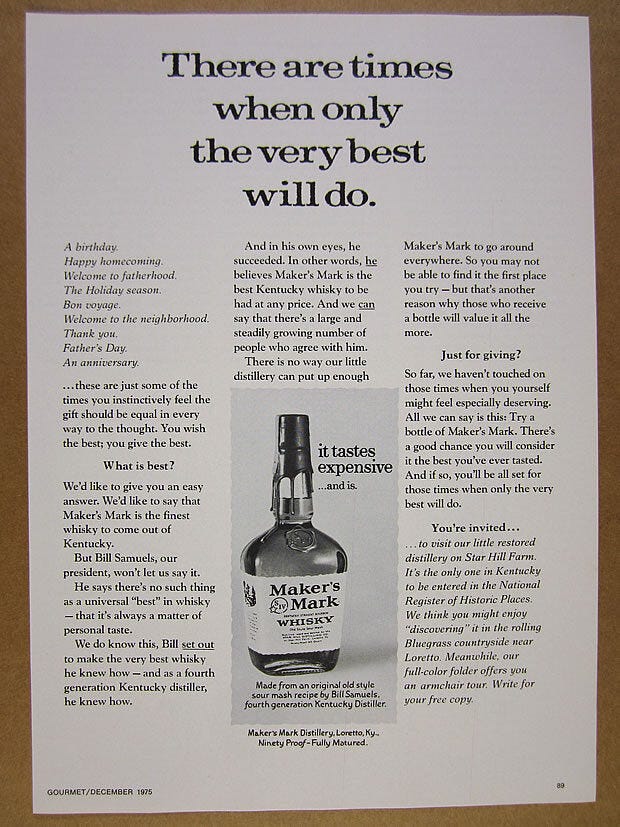
And this 1975 ad is an example of why.
Copy overview
There are times when only the very best will do.
A birthday.
Happy homecoming.
Welcome to fatherhood.
The holiday season.
Bon voyage.
Welcome to the neighbourhood.
Thank you.
Father’s Day.
An anniversary.
…these are just some of the times you instinctively feel the gift should be equal in every way to the thought. You wish the best; you give the best.
What is the best?
We’d like to give you an easy answer. We’d like to say that Maker’s Mark is the finest whisky to come out of Kentucky. But Bill Samuels, our president, won’t let us say it. He says there’s no such thing as a universal ‘best’ in whisky – that it’s always a matter of personal taste.
We do know this. Bill set out to make the very best whisky he knew how – and as a fourth generation Kentucky distiller, he knew how.
And in his own eyes, he succeeded. In other words, he believes Maker’s Mark is the best Kentucky whisky to be had at any price. And we can say that there’s a large and steadily growing number of people who agree with him.
There is no way our little distillery can put up enough Maker’s Mark to go around everywhere. So you may not be able to find it the first place you try -but that’s another reason why those who receive a bottle will value it all the more.
Just for giving?
So far, we haven’t touched on those times when you yourself might feel especially deserving. All we can say is this: Try a bottle of Maker’s Mark. There’s a good chance you will consider it the best you’ve ever tasted. And if so, you’ll be all set for those times when only the very best will do.
You’re invited…
…to visit our little restored distillery on Star Hill Farm. It’s the only one in Kentucky to be entered in the National Register of Historic Places. We think you might enjoy ‘discovering’ it in the rolling Bluegrass countryside near Loretto. Meanwhile, our full-colour folder offers you an armchair tour. Write for your free copy.
Brand associations and emotional resonance
- Belonging: The main idea of the ad is to position Maker’s Mark as the ideal gift for any occasion. This idea is presented as soon as the ad opens with a list of various events. It’s capped off by a personal invitation to the distillery as a gift that’s being given to the reader.
- Prestige: Maker’s Mark has always positioned itself as a prestigious and luxurious product, dating back to its early days with the tagline ‘it tastes expensive…and it is.’ The ad leans into this association by constantly referencing what the best whisky is in the market.
- Humility: A tactic that worked well for Maker’s Mark when it started in the ‘50s and ‘60s was cultivating a mom-and-pop image. The Samuels were a small, underdog family fighting to make themselves heard against established bourbon brands like Jack Daniels and Jim Beam. These humble roots are splashed all over the ad with phrases like ‘our little restored distillery.’
- History: Another marketing tactic Maker’s Mark tapped into was always calling out the fact that its distillery was a registered national historical landmark. This is mentioned at the end of the ad to entice customers to come directly to the farm.
Copywriting Takeaways
Say what you’re saying without actually saying it
A cool copy trick with this ad is that Maker’s Mark positions itself as the best bourbon without ever claiming it is the best. This is achieved in a few ways:
- There’s a big deal made about Bill Samuels not letting his team call Maker’s Mark the best whisky – and then the ad references the large following that the brand has. It’s a classic ‘don’t take our word for it…’ argument.
- There’s a veneer of humility created by the line ‘there’s no way our little distillery can put up enough Maker’s Mark to go around everywhere.’ It’s a subtle way of hinting that Maker’s Mark is so popular that the Samuels can’t fill demand.
- The line ‘best Kentucky whisky to be had at any price’ calls out that Maker’s Mark is worth paying more for than cheaper bourbons.
Stay humble, even when you’re not
As I’ve said, the ad creates the image of Maker’s Mark being an underdog brand, even though it was anything but by 1975.
A way you can do this for your drink brand is to directly reference your origins.
Maybe you started home brewing in your tiny flat. Maybe you busted your ass to learn about a specific drink category while balancing your day job.
The point is, we’re hardwired to appreciate an underdog story so don’t be afraid to mention how much you’ve grafted to secure certain ingredients and connections etc.
Call for direct participation
The ad ends with a call to action for the reader to write directly to Maker’s Mark to receive a free folder/map of the Star Hill Farm.
That’s direct response copywriting at its most basic – Reply to this thing and we’ll give you this thing.
What’s great about this call to action is that readers would have presumably had to write a letter to Maker’s Mark.
In today’s world, writing anything physical requires a lot more effort than just responding to an email.
That could be your differentiator.
Take out a print ad and ask your customers to send a letter or card to you in exchange for something free.
 Americana Aspects
Leave a comment