
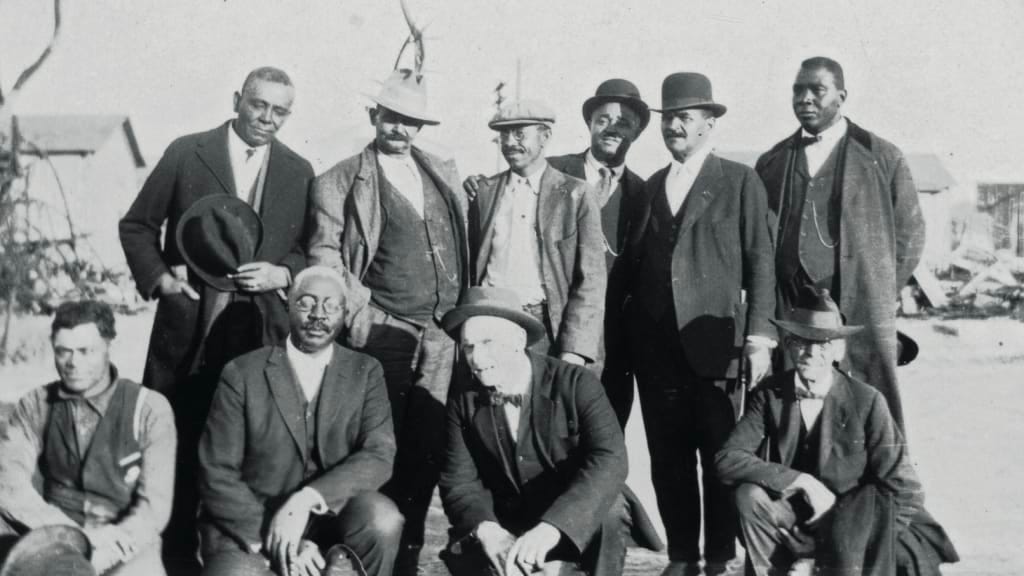
History is filled with examples of property developers and investors who went against the grain and improved their own lives and the area around them.
And one developer in the early 20th century created a place that would come to be known as Black Wall Street. His name was Ottowa W. Gurley and he (literally) changed the landscape of Florida forever.
Early days
Born in 1893 to former slaves, Gurley grew up in Huntsville, Alabama. The atmosphere of his childhood was that of the Jim Crow racism that suffocated black people and locked them out of opportunities for a better life. But Gurley wouldn’t let the attitudes of the South stop him from making something of himself.
Going to public school and being self-educated, Gurley eventually became a teacher. Then, he moved on to a job at the US Postal Service, with dreams of doing more with his life. In 1889 he married his childhood sweetheart Emma Wells and the couple decided to throw caution to the wind.
Opportunity was to be found for those who were brave enough to risk it all with the Great Oklahoma Land Rush of 1893. And so on September 16th of that year, Gurley and his wife packed up and left to become homesteaders in what would become Perry, Oklahoma.
The twenty-five-year-old visionary saw a place that could provide emancipated black people with new ways of living and he wasted no time in trying to make his mark. Gurley unsuccessfully ran for treasurer of Noble Country, though he became headteacher of the town’s school and opened up a general store. He ran the store for ten years.
Making a change
By 1905, Gurley had heard tales of the oil boom going on in a town called Tusla. Oil wells seemed to be turning unknowns into overnight success stories and he planned on being one of them. Arriving in Tusla, Gurley bought 40 acres of land in the north of the town across the Frisco train tracks. Upon this barren plot of land, Gurley started bringing his long-gestating vision of a black community to life.
Gurley rightfully understood that sharecroppers and freemen wold come to Tusla to seek their fortunes. So, he built a grocery store that could provide jobs and a rooming house where black people could stay without fear of prejudice. This area became known as Greenwood, named after a town in Mississippi. Gurley further divided the thriving hub into commercial and residential lots and Greenwood boomed with potential.
Subscribed
The founder of what would become Black Wall Street joined forces with fellow businessman and developer J.B Stradford. He also focused on real estate and they built their community in tandem, with the crown jewel of Stratford’s portfolio being the Stradford Hotel. This was the biggest Black-owned hotel in America at the time. It housed 54 suites, a gmabling hall, saloon and pool hall.
Meanwhile, at the height of his powers, Gurley owned five townhouses, a grocery store, rented three apartment buildings, a hotel, a Masonic Lodge and an employment agency for migrant workers.
But Gurley didn’t just stay within Black Wall Street. He ventured to the other side of the tracks, building relationships with wealthy white Tulsans. Eventually, he became the sheriff’s deputy and was charged with looking after the black population.
With a portfolio priced at over $150,000, nearly $5 million by today’s standards, Gurley had come a long way since his humble childhood days.
According to historian Hannibal B Johnson, he was responsible for Greenwood being “perceived as a place to escape oppression – economic, social, political oppression – in the Deep South. It was an economy born of necessity. It wouldn’t have existed had it not been for Jim Crow’s segregation and the inability of black folks to participate to a substantial degree in the larger white-dominated economy.”
But nothing lasts forever. And a brewing storm of tension would change the course of Black Wall Street for the worst.
Down in flames
For years, Greenwood had stood tall and even the First World War couldn’t slow down its growth. However, with hundreds of thousands of black veterans returning from the war the summer of 1919 turned red. White supremacy sparked with a fear of communism and the powder keg exploded in Tusla. Lynchings happened across town and in 1921 a black shoeshiner called Dick Rowland was accused of raping a white woman.
The story was touted by the media and an outraged mob gathered around the jail that Rowland was being kept in. Armed men eventually went inside to protect him, while peacekeepers like Gurley tried to ease tensions. It was futile. Shots were fired and on the morning of June 1st, Greenwood was burning.
At the end of the Tulsa Race Riot, a reported 50 white people and 200 black people had died, while 35 square blocks of Greenwood had been demolished. Survivors were rounded up by the National Guard into internment camps and Gurley was among them.
He’d lost the bulk of his fortune and Greenwood’s total property loss was roughly $50 million in modern currency.
Weeks later, he and his wife were released and Gurley was eventually brought in as a witness to indict Stratford as one of the key agitators of the riot. He testified that his former business partner had given orders for Rowland to be defended from a lynching. With his wealth diminished, Gurley then moved to Los Angeles, where he and his wife ran a small hotel until he passed away.
Gurley’s legacy is that of a real estate tycoon who genuinely wanted to improve the lives of his community with his developments and investments. And in the decades since the memory of Greenwood has been kept alive through various initiatives.
 Americana Aspects
Leave a comment